

The Internet Bubble Makes AI Look Bigger Than It Is

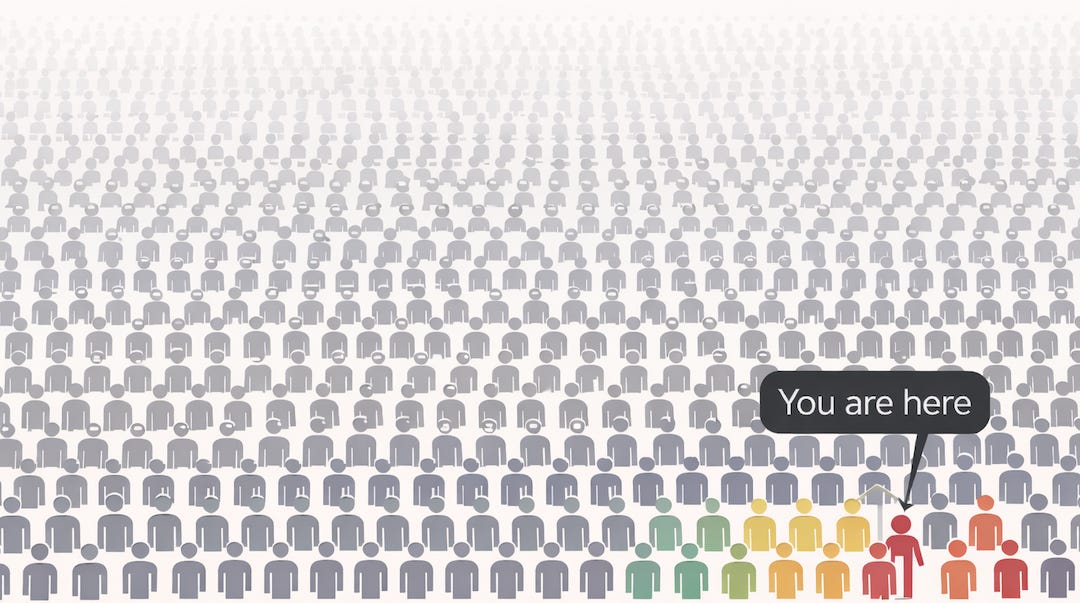
Spend enough time on X or LinkedIn and it starts to feel like the entire world is already using artificial intelligence.
Every morning brings a new announcement. A new model. A new framework. Someone claiming they automated half their business in a weekend. A 19-year-old building a startup from a dorm room using tools most of us hadn’t even heard of a month ago.
After a while it creates a strange feeling.
Like the train has already left the station.
Like everyone else has figured something out that you haven’t.
I feel it too.
And then every once in a while something comes along that snaps that illusion in half.
Recently I saw a visualization circulating online that did exactly that. It showed the world’s population represented as 2,500 small squares. Each square represented about 3.2 million people.
This graphic is incredibly telling and will change the way you see the current state of artificial intelligence.
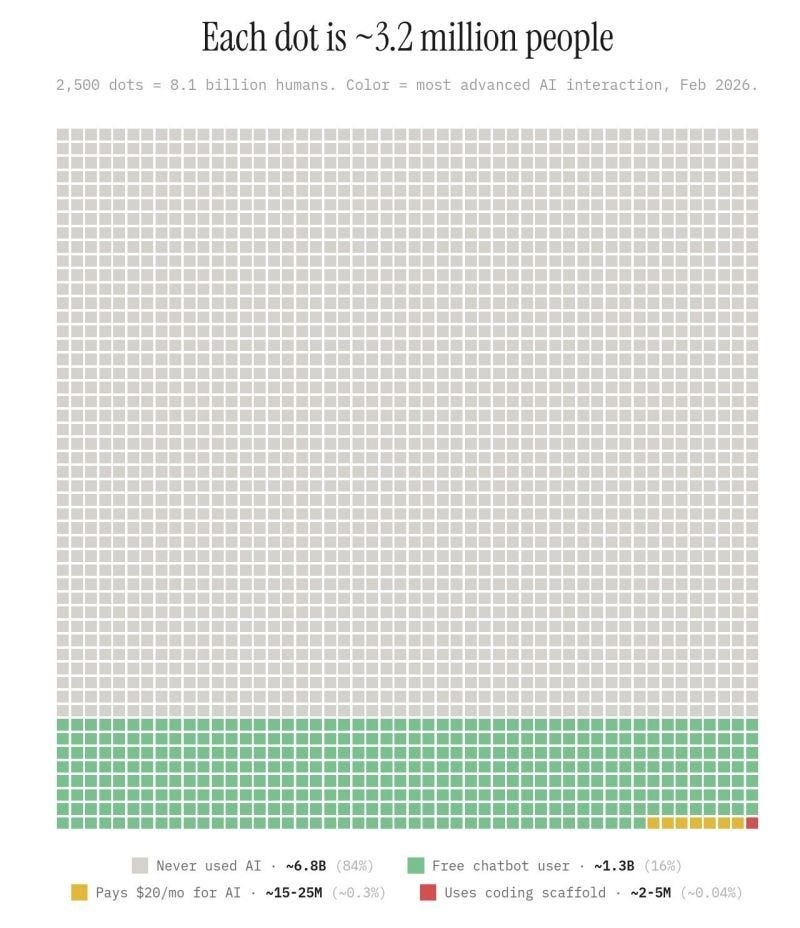
The graphic broke the world’s population into a grid of tiny squares.
Most of them were gray.
Gray meant people who have never used AI at all.
And there were a lot of gray squares.
According to the estimates used in the graphic, that’s roughly 6.8 billion people.
At the bottom was a small strip of green squares representing people who have used a free chatbot.
That group is about 1.3 billion people.
Then there was a tiny sliver of yellow representing people who actually pay for AI tools. Something like 15 to 35 million people worldwide.
And finally a microscopic red line representing the people using AI at a deeper level — developers, builders, automation enthusiasts.
Just a few million people on a planet of eight billion.
If those numbers are even remotely close to reality, something interesting becomes obvious.
The internet conversation about AI is happening inside an incredibly small bubble.
The Loudest People Are The Earliest Adopters
If you spend time where I do — tech conversations, AI communities, startup circles — it feels like the revolution has already happened.
But that’s not the real world.
That’s the early adopter layer.
Every major technology starts this way.
The people closest to the technology assume the rest of the world is moving just as fast as they are.
In reality, most people are still figuring out the basics.
Right now there are still millions of people who have never opened ChatGPT. They’ve heard of it. They may have read an article or two about AI in the news. But they haven’t tried it themselves.
Even in the United States, one of the most technologically advanced countries on the planet, surveys suggest that a majority of adults have never used ChatGPT.
That’s remarkable when you think about how often the tool appears in headlines.
Meanwhile on tech Twitter people are debating agent frameworks and multi-model orchestration.
Two completely different realities.
The Internet Has Always Distorted Time
This isn’t the first time we’ve seen this phenomenon.
The internet compresses the future.
When you’re immersed in technology conversations, it can feel like the entire world changes overnight.
But large-scale adoption almost never works that way.
Take the internet itself.
The World Wide Web became publicly available in 1991. But it took more than a decade before most households were actually online.
Broadband didn’t become common until the mid-2000s.
Social media didn’t become mainstream until the late 2000s.
From invention to mass adoption, the timeline stretched out over years.
Sometimes decades.
Yet if you lived inside the tech industry during those periods, it probably felt like everything was happening instantly.
The same pattern is repeating with AI.
Most People Aren’t Waiting For AI
Another thing that’s easy to forget inside the tech bubble is that most people aren’t sitting around thinking about artificial intelligence.
They’re thinking about their jobs.
Their families.
Their businesses.
Their bills.
AI only enters the picture when it solves a real problem.
A small business owner might try AI when they realize it can help write marketing emails faster.
A student might use it when they need help understanding a difficult concept.
A traveler might use it to plan a trip.
But outside of those moments, it isn’t part of their daily mental landscape.
And that’s perfectly normal.
Technology adoption usually starts with curiosity, then moves into usefulness, and eventually becomes invisible.
Electricity followed that path.
So did the internet.
So did smartphones.
AI Is Still In The “Early Electricity” Stage
Think about electricity.
When it first appeared, people treated it like a spectacle. Demonstrations. Experiments. Newspaper stories about the strange new power that might change everything.
But daily life didn’t transform overnight. It took years before the wires reached most homes.
It took years before electric power spread widely through homes and businesses.
At some point, the technology stopped feeling extraordinary.
It just became infrastructure.
Something you expect to work when you flip a switch.
AI may be heading toward the same destination.
Right now it still feels like a novelty to many people.
But over time it will likely become embedded inside the tools we already use.
Email systems will summarize messages automatically.
Software will help draft reports and presentations.
Customer support systems will answer questions instantly.
The intelligence will fade into the background.
And most people won’t even think about it as “AI.”
It will just be how things work.
The Real Barrier Isn’t Technology
Many discussions about AI adoption focus on skills.
Companies say they can’t find workers who understand the tools.
Executives worry their teams aren’t trained well enough.
But the deeper barrier may be simpler than that.
Curiosity.
Millions of people assume AI is something complicated.
Something technical.
Something meant for programmers.
So they never try it.
The first experience with AI often changes that perception quickly.
Ask a question.
Get a thoughtful answer.
Upload a document.
Receive a clear summary.
Suddenly the technology feels approachable.
But someone has to take that first step.
And most people haven’t yet.
The Gap Between Perception And Reality
This is where the visualization I mentioned earlier becomes so interesting.
If the estimates are even roughly correct, the people who feel surrounded by AI are looking at a very small slice of humanity.
A few million highly engaged users.
The rest of the planet is somewhere behind that curve.
Some are experimenting casually.
Some are curious but hesitant.
And billions have not interacted with AI at all.
That gap between perception and reality creates a strange dynamic.
Inside the tech bubble, people worry they’re falling behind.
Outside the bubble, many people haven’t started yet.
Early Still Means Opportunity
Whenever a technology sits at this stage — widely discussed but not widely adopted — an interesting window opens.
People who understand the tools even a little can help others make sense of them.
That might mean teaching.
Explaining.
Demonstrating.
Or simply translating complex ideas into practical uses.
In the early days of the internet, thousands of businesses emerged doing exactly that.
Helping companies build websites.
Helping organizations set up email systems.
Helping people navigate the new digital world.
Those opportunities existed because the technology arrived faster than most people could absorb it.
AI may be following a similar path.
Not because the tools are mysterious.
But because they’re arriving faster than society can comfortably digest them.
The Missing Insight: Most People Won’t Know They’re Using AI
One of the biggest mistakes people make when thinking about AI adoption is assuming people will consciously choose to use AI.
Most won’t.
Just like most people never decided to “use algorithms” or “use cloud computing.”
It simply showed up inside the tools they already used.
The Smartphone Analogy
When the iPhone launched in 2007, people talked about “smartphone adoption.”
But what really happened?
Phones just became smart.
People didn’t sit around saying:
“Today I’m going to adopt smartphone technology.”
They bought a phone.
The technology disappeared into the experience.
AI Will Likely Follow The Same Path
Right now people talk about ChatGPT, Claude, Gemini and the latest AI apps as if they’re separate destinations you have to visit.
But eventually AI won’t be a separate category.
It will simply be how software works.
Your email client will summarize messages.
Your calendar will propose schedules.
Your word processor will help draft text.
Your accounting software will analyze trends.
And most people will never think:
“I’m using artificial intelligence.”
They’ll just think:
“This software is helpful.”
The Real Adoption Curve Will Be Invisible
That visualization showing billions of people who “haven’t used AI yet” is powerful.
But it also hides something important.
A lot of those people will become AI users without realizing it.
The technology will arrive quietly.
Embedded in the tools they already rely on.
Which means the real moment AI becomes mainstream might not be dramatic at all.
It might happen gradually…
Until one day we look around and realize everything works a little differently than it used to.
A Calm Before the Storm
If history is any guide, the next few years may look very different from today.
Once a technology crosses a certain threshold of usefulness, adoption tends to accelerate.
Smartphones did this around 2010.
Social media did it a few years earlier.
The internet itself eventually became unavoidable.
AI may still be in the quiet phase before that acceleration.
The phase where the technology exists, the potential is obvious, and the early adopters are racing ahead.
But most of the world hasn’t fully joined in yet.
Which means something important.
Despite the noise online, despite the feeling that everything is happening at once…
We may still be very early in the story.
And the next chapter hasn’t even started yet.
How does it make you feel to know that you are in such a small minority of people who are even in touch with what’s happening now?