
The Reflection Wouldn’t Walk Away

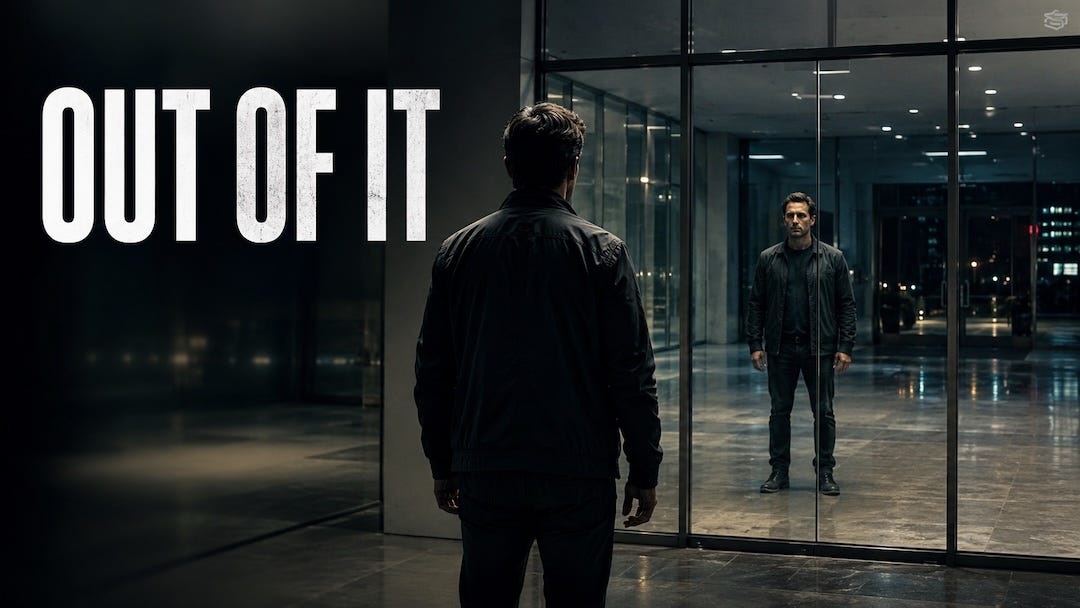
I just wanted one shot.
A man stops in front of glass. His reflection keeps going.
Three seconds. Perhaps four at most. In my head, the whole film hung on it.
Unfortuntely, I never got that shot. Not once, across more attempts than I want to put in writing. AI video models can do incredible things now. But making a reflection disobey the person casting it is not one of them.
So I rewrote the scene. Instead of a reflection breaking the rules, another version of the man appears on the far side of a glass door. Same feeling, but different physics. It generated this one much easier.
And I have to admit, it’s better. Not “acceptable given the limitations” better. Actually better. A reflection that walks away is a gimmick. A man standing on the other side of the door is a threat.
That happened to me over and over for the length of a two minute movie. And the creation of that two minute movie ate up my whole day.
What I made
For my latest experiment with AI, I wanted to create a short psychological mystery. It was to be roughly two minutes, start to finish. I generated every scene with AI, mostly Kling for the video, Filmora for the edit and the sound.
I didn’t start with a script. I started with a feeling and a couple of images, and I let the thing find its own shape through dozens of iterations. Scenes got rewritten. Whole concepts got thrown out when the technology couldn’t manifest them. What survived was a story about a man who spent his life doubting his own perceptions, only to find out he wasn’t imagining any of it.
The line the film turns on arrived at the end:
“We just taught you not to trust yourself.”
That wasn’t in my iPhone note where I created a one-line idea for a story more than a year ago. It surfaced as I sought to bring the story to life.
Nobody types one prompt
Many people assume that AI video generation is as simple as describing a scene and walking away.
It’s actually more complicated and involved than that. First you write the beat. Then you click to generate. Almost always, you get get a result that’s almost right. But the character’s jacket changed color. So you regenerate. Then the camera drifts the wrong direction. So you rewrite the description. Regenerate again. Only to get something usable at second twelve and hot trash at second thirteen.
Multiply that by every shot in the film and you have a better idea of how it really works.
Prompting isn’t the star of the show. The real work is in the watching, the discarding, and the deciding. I spent far more time evaluating output than requesting it, which is exactly what directing has always been.
The tools have opinions
You learn their preferences fast, mostly by walking into walls.
Text on screen is still a losing fight. Signs, screens, book spines, anything with letters still can come back as gibberish. So you shoot around it. A monitor becomes a rectangle of colored light. A sign becomes something the camera never quite gets a clean look at.
Hands in motion are risky. Faces hold together better at a three quarter angle than straight on. Continuity across shots takes deliberate effort, because the model has no memory of the man it drew ninety seconds ago.
None of that is a complaint. Every medium comes with a list of things it does badly, and the craft has always been knowing the list. Spielberg’s mechanical shark kept breaking, so he shot the water instead of the animal, and Jaws got scarier. Constraint has been doing this job for a long time. The tools are new. The situation isn’t.
Constraint as a co-writer
The limits didn’t only make the film cheaper. They made it better, which I wasn’t expecting.
Every time the technology refused an idea, I had to ask what the idea was really for. The reflection wasn’t about reflections. It was about a man meeting evidence he couldn’t explain away. Once I understood that, the glass door was sitting right there, simpler and meaner than what I’d planned.
That pattern repeated:
A complicated blocking idea became a single held frame, and the held frame carried more dread
Dialogue I loved got cut because the delivery never landed, and the silence felt stronger
A visual metaphor I was attached to turned into a smaller, plainer image that people actually understood
If you cling to your original vision, you’ll spend your budget of patience fighting the tools. If you’ll let the idea evolve, the thing turns into a collaborator with infinite stamina and no ego.
What stayed human
Everything that mattered.
The emotional arc. The pacing. Which beat to hold two seconds longer than feels comfortable. Where the music enters and where it drops out. The order of reveals. The ending. The decision that this line and not that one is the sentence the audience hears.
AI generated possibility. It also exposed weakness with brutal efficiency, because when a scene is emotionally hollow, watching thirty variations of it makes that obvious in a hurry. It accelerated experimentation to a speed I’ve never worked at before.
It made zero choices. Not one. Taste doesn’t come in the form of a prompt or generative clip.
One person, no crew
Two minutes of narrative film with locations, a cast, night exteriors, and controlled lighting would have meant a crew, a schedule, insurance, permits, and money. Not indie money. Real money. A few years ago this project was simply out of reach for one person working alone.
I made it all by myself, and the largest expense was my own stubbornness.
Yes, AI can do amazing things with video. But it doesn’t mean filmmakers are finished. Just watch what a great director does with a great cinematographer and try to tell me a text prompt can do the same thing. What it means is that the distance between imagining something and seeing it become in reach for people who never had access at all. The kid with a story and no film school is now one iteration cycle away from a rough cut.
Some of what comes out of that will be terrible. But humans have been proficient in creating slop films for decades. And to be clear, I don’t pretend that my two-minute film is any good. The interesting question is what the ones who stick with it will make in five years.
We’re at the front of this
I’ve been in enough of these disruptions to recognize what they look and feel like. The tools are clumsy in specific, documentable ways. But they’ll be less clumsy in six months. The people learning to work with them right now, learning where to bend them to their will, are building a skill that’s going to look like craft before this decade is out.
It’s not about prompt engineering. I’d say it’s something closer to knowing your instrument. You have to know it well enough to know what it can and can’t do.
I went looking for a reflection that walks away. I found a man behind a door instead, and he ended up being more profound.
Maybe I’ll try something really crazy next time.
Here’s my first attempt at a short film using AI.
The film and a few other things I’ve been building live at ArtificialIntelligence.studio.
A bit deep there Joel - You been knocking on the door of 'The Universal Knowledge-Bank' again? :-)
Interesting. I could take the theme or message a couple different directions. You left me wanting a bit more.
But that isn't really my point. :-)
The main and very cool point is that I'm thinking about the content and the meaning, not the mechanics. The media is almost 100% transparent and was a good vehicle for the theme. I was not focused on AI-ish stuff, but on what was happening and what it meant.
P.S. Was the main character kinda how you picture yourself at in your mid-to-late 30s? I'd probably do that, to be honest, therefore everyone falls under suspicion.