
Your Idea Doesn't Need a Team. It Needs a Tuesday Night.

I’ve been on the internet a very long time.
Not using the internet. On it. Building businesses on it. Writing books about it. Standing on stages explaining to rooms full of people what was coming next and why it was important.
I watched the web go from GeoCities to Google. I built ClassicGames.com and sold it to Yahoo. I launched one of the first thousand apps in the App Store. I wrote a New York Times bestseller about monetizing websites before most people knew what AdSense was. I got into crypto early, NFTs early, and have spent the last eight years behind a podcast mic with Travis Wright telling people what’s happening in tech before it happens.
I’ve always been one of the guys who sees it first.
But I was never the guy who built it. I just didn’t have technical competency for design, programming or site-building.
I had teams for that. Developers, designers, project managers. I’d have the idea, describe the vision, pace around the room making hand gestures while talented people turned my words into working software. And that worked. For three decades, that worked just fine.
Until it didn’t have to work that way anymore.
Everything Changed
In 2023, like everyone else, I discovered AI. Unlike most people, I didn’t just play with it. Travis and I launched a show. We called it The BadAI Show, because of course we did. We were going to cover the AI space the way we covered crypto: two guys breaking it down, making it accessible, having fun with it.
We made 20 episodes.
It wasn’t that the show was bad. It’s that the space was moving at a speed that made weekly coverage feel more challenging then we had time for. Others were producing daily content and we realized we didn’t want to compete.
So we stopped.
But we didn’t stop using it.
Can I Do This?
Everyone has an AI story, but many don’t acknowledge the long, quiet middle. The part between “wow, this is cool” and “I can actually do something with this.” Most people are still in that middle. Using ChatGPT to write emails. Asking Claude to summarize articles. Dabbling. Poking at it. Knowing it’s powerful but not quite knowing what to do with that power.
I was there for almost three years.
I used AI every day. I got good at prompting. I understood what the models could do. But I was still the idea guy. I was still describing what I wanted and waiting for someone, or some model, to hand it back to me in a form I could publish. The gap between my brain and a shipped product was smaller, but it was still a gap. (AI has convinced me that the word “gap” is actually quite descriptive.)
Then something shifted in early 2026.
I started seeing people build things. Not developers. Not engineers. Regular people on X. Associates on Telegram. These were creators, entrepreneurs, writers, all spinning up real tools, real websites, real applications. Not demos. Not toys. Actual products. And they were doing it with AI as their engineering partner.
I watched this for months, feeling intimidated by OpenClaw and Claude Code. That was above my pay grade.
But then I had the thought that changed everything:
If they can do it, I can do it.
From User to Practitioner
I’d been talking to Claude for a while. But there’s a difference between using AI as a search engine with personality and using it as a collaborator. I made the switch. I stopped asking Claude to give me answers and started asking it to teach me how to build.
The first thing I learned is that Claude is absurdly patient. I asked dumb questions. I broke things. I pasted error messages I didn’t understand and said “what does this mean and what do I do.” And every single time, I got a clear, step-by-step response that met me exactly where I was.
No judgment. No “well, actually.” Just: here’s what happened, here’s why, here’s how to fix it, and here’s what to do next.
Then I found Claude Code, and the walls came down.
I started building websites. Then tools. Then games. An entire games hub with daily-updating puzzles. A deals site that scans and publishes automatically. React-based tools for a growing portfolio of digital properties. Bots that run 24/7 on virtual servers, publishing content, scanning markets, doing things I used to need a team and a monthly retainer to accomplish.
I didn’t hire anyone. I built it. Me. The guy who’s been having ideas for 30 years and paying other people to make them real.
It Took 18 Years
And then last night happened.
In 2008, I submitted one of the first 1000 apps to the iOS App Store. It was called iVote Mobile. It was a great experiment and led to the next app my team developed, iFart Mobile. That one became the #1 app in the world for a brief, glorious, ridiculous moment. It made headlines. It made money. It made people laugh. It still does eighteen years later.
But I didn’t build it. I had the idea. My team did the work. They wrote the code. They created the graphics. They compiled it. They dealt with Xcode and provisioning profiles and all the things that make app development feel like you need a computer science degree and a high tolerance for frustration.
I described what I wanted. They made it happen. I got the credit.
That was the pattern. For 18 years, that was the pattern.
As I mentioned earler, I build a series of daily games. A few days ago, I wondered if I might be able to turn those daily games into an iPhone app so others could install and play on their devices.
So I asked Claude to help me through the process of turning the games into an app.
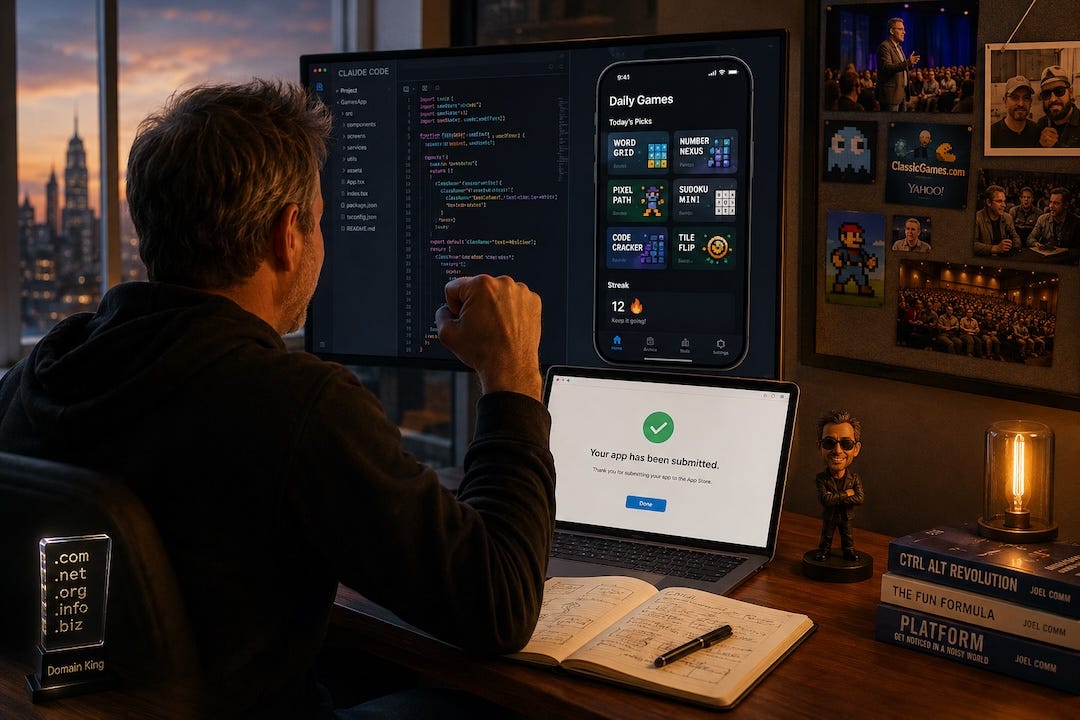
And last night, I sat on my sofa, opened Claude Code, and walked through the entire process of validating and submitting an app. I wrote the logic, I debugged the errors, I configured the build, I compiled it, and I clicked Submit on App Store Connect.
My finger. My click. My build.
No team. No Slack channel. No “hey, can you take a look at this” message to a developer in another time zone. Just me and an AI that had the patience to walk me through every step and the intelligence to understand what I was trying to do before I fully understood it myself.
When the submission went through, I sat there for a minute just looking at the confirmation screen.
My fiancee walked into the room and I jumped up from the sofa excitedly saying “I did it!” We connected with a high five and celebrated the moment.
Honestly, it’s not even about the app itself. Hopefully it gets approved without any issues. But if not I’ll just go back to Claude and we will fix whatever issues arise.
The celebration was really about what the moment represented. For the first time in 30 years, the distance between my idea and a shipped product was zero. The hurdle was removed. Not because I suddenly became a developer. Because the tools finally caught up to people like me.
I Built That
I know what some of you are thinking. “Joel, you didn’t really build it. The AI built it.”
No. I built it.
Claude didn’t have my idea. Claude didn’t know what I was trying to make, or why, or who it was for. Claude didn’t make the product decisions, the design choices, or the call on what to ship and what to cut. Claude didn’t sit there at midnight squinting at an error message and deciding whether to push through or go to bed.
I did all of that. Claude was the most capable, most patient collaborator I’ve ever worked with. But it was a collaborator, not a creator. The vision was mine. The decisions were mine. The Submit button was mine.
That’s what people miss about this moment in technology. AI doesn’t replace the person with the idea. It removes the barriers between the idea and the thing. For my entire career, those barriers were other people’s skills, other people’s time, and other people’s availability. I needed a team because I couldn’t do it alone.
Now I can.
And you can, too
I’m not writing this to brag. I’m writing it because I know exactly who’s reading this.
You’re the person with the idea. You’ve had it for months, maybe years. You’ve priced out developers on Upwork. You’ve described your vision to freelancers who didn’t quite get it. You’ve maybe even started and stopped a few times because the difference between what’s in your head and what you can execute felt too big.
I was you. For 30 years, I was you.
It’s all changed now. The tools exist today, right now, not in some future update, to take what’s in your head and put it in the world. You don’t need to become a developer. You don’t need to learn to code in the traditional sense. You need to learn to communicate with an AI that can code, and then you need to start.
That’s all there is to it.
I’ve been on the internet since 1995. I’ve seen every wave. I’ve written about them all, spoken about them all, podcasted about them all.
This is different.
This isn’t a wave. It’s the water level rising permanently. The barrier between “idea person” and “builder” doesn’t come back after this. It’s gone. And the people who understand that right now, while most people are still using AI to rewrite their LinkedIn bios, are the ones who are going to build the next decade.
I submitted my first app to the App Store in 2008. Someone else built it.
I submitted an app to the App Store last night. I built it myself.
Start building.
Very inspiring article, Joel. I've been writing Core Message Platform "master messaging" documents for many years. Made a good living do it. For years I've been thinking about how to turn my system for writing them into an app I can sell. Because after all these years, I've hit that point where I...just...can't...write...another one. So thanks for sharing this roadmap.